Why the Titanic? An Exploration of Its Historical Context, Purpose, and Significance

0

The RMS Titanic, launched on May 31, 1911, stands as one of the most iconic vessels in maritime history, not merely for its tragic fate but for the ambitious circumstances of its creation. Its construction was a response to a complex interplay of technological innovation, economic competition, and societal transformation in the early 20th century. This article examines why the Titanic was built, exploring the historical context of its inception, its intended function, and its role within the fierce rivalry among shipping companies and the transatlantic immigration trade. Drawing on the expertise of naval historians and firsthand accounts, this analysis situates the Titanic and its Olympic-class siblings within a broader narrative of industrial ambition and human mobility.

Propaganda poster (1911)


Historical Context: The Age of Steam and Imperial Ambition


The late 19th and early 20th centuries marked a golden age of maritime engineering, driven by the transition from sail to steam and the adoption of iron and steel hulls. Britain, at the zenith of its imperial power, depended on its merchant fleet to maintain economic dominance and connect its far-flung colonies with the metropole. The Titanic was conceived in this milieu, where shipbuilding was not just an industry but a statement of national identity. Historian Richard Davenport-Hines (2012) asserts, "The liners of this era were not just transport vessels but floating embodiments of national pride and technological supremacy" (p. 23), a sentiment echoed in the public fascination with each new ship’s launch.


This period was also defined by rapid industrialization and globalization. The Second Industrial Revolution brought advancements in metallurgy and propulsion, enabling the construction of ever-larger vessels. The British shipbuilding industry, centered in hubs like Belfast and Glasgow, became a powerhouse, employing tens of thousands and fueling economic growth. The Titanic’s builder, Harland & Wolff, was a linchpin of this ecosystem, with a workforce of over 15,000 at its peak (McCluskie, 2013). Its construction was a testament to Britain’s industrial capacity, employing cutting-edge techniques like hydraulic riveting and massive gantry cranes.


Moreover, the geopolitical landscape shaped the Titanic’s genesis. The British Empire faced growing competition from Germany and the United States, both of which were flexing their industrial muscles. Germany’s Kaiser Wilhelm II championed his nation’s shipping lines as tools of imperial prestige, while America’s economic rise drew millions of European emigrants westward. Historian John Maxtone-Graham (2014) notes, "The transatlantic liners were the arteries of this migration, carrying not just the elite but also the huddled masses of steerage passengers" (p. 87). The Titanic was thus a product of both imperial rivalry and the socioeconomic currents of mass mobility, designed to reinforce Britain’s maritime supremacy.


Function and Design: A Floating Palace for a New Era


The Titanic was not built to chase speed records but to redefine the passenger experience through unprecedented size, luxury, and reliability. Measuring 882 feet in length and boasting a gross tonnage of 46,328, it was the largest ship afloat upon its completion. Designed by Harland & Wolff’s chief naval architect, Thomas Andrews, the ship incorporated advanced engineering features: a double-bottomed hull, 15 watertight bulkheads with remotely operated doors, and a cellular structure intended to enhance stability (Beveridge, 2008). These innovations led to its reputation as "unsinkable," a claim popularized by the press and White Star Line’s marketing, though Andrews himself never endorsed it outright.

Arrol Gantry at Harland and Wolff in 1970 shortly before it was demolished (Reddit)


The ship’s primary function was to serve as a weekly mail and passenger liner on the Southampton-to-New York route, a critical artery of transatlantic commerce. Its first-class accommodations were a marvel, rivaling Europe’s grandest hotels. Passengers enjoyed a heated swimming pool, a squash court, a gymnasium with electric exercise machines, and a Turkish bath suite complete with steam rooms and masseurs. The grand staircase, crowned by a glass dome and adorned with carved oak paneling, became an enduring symbol of its opulence. Mrs. Frank Warren, a first-class survivor, recalled in 1912, "It was like stepping into a dream—every detail was exquisite, from the crystal chandeliers to the plush carpets" (as cited in Lord, 1955, p. 45). Such extravagance was a deliberate strategy to attract affluent travelers willing to pay fares equivalent to thousands of dollars today.

Yet, the Titanic’s design also catered to the broader passenger market. Its second-class cabins offered comforts—private bathrooms, a library, and a smoking room—that surpassed many competitors’ first-class offerings. Third-class facilities, while austere by comparison, marked a significant improvement over earlier immigrant ships. With a capacity for over 900 steerage passengers, the ship provided separate berths, two dining saloons with long tables, and basic sanitation, a stark contrast to the open-deck squalor of 19th-century "coffin ships." Historian Don Lynch (2018) explains, "White Star saw the immigrant trade as a numbers game; the more passengers they could carry in tolerable conditions, the greater the profit" (p. 112). This dual-purpose design—luxury above, utility below—reflected the ship’s role as both a status symbol and a workhorse of the Atlantic trade.


The Technological and Business Race: Olympic-Class as a Competitive Edge


The Titanic’s creation was a direct response to the fierce competition among shipping companies, a rivalry historian Robert Ballard (2017) describes as "a high-stakes chess match played with steel and steam across the Atlantic board" (p. 59). Cunard Line’s Lusitania and Mauretania, launched in 1906 and 1907, had redefined the industry with speeds of 25 knots, securing the Blue Riband and lucrative mail contracts subsidized by the British Admiralty, which saw them as potential wartime auxiliaries (Gardiner, 2001). White Star Line, under J. Bruce Ismay’s leadership and bolstered by J.P. Morgan’s International Mercantile Marine (IMM) after its 1902 takeover, rejected speed in favor of scale and luxury.

The Olympic-class liners—Olympic (1911), Titanic (1912), and Britannic (1914)—were White Star’s audacious riposte. The Titanic’s construction cost £1.5 million (approximately £150 million today), a sum that included £100,000 for interior fittings alone (Eaton & Haas, 2013). Its launch on May 31, 1911, drew over 100,000 spectators in Belfast, with the hull sliding into the River Lagan amid cheers and cannon fire—a spectacle captured by Pathé newsreels and heralded as "the greatest shipbuilding achievement in history" (The Times, June 1, 1911, as cited in McCluskie, 2013, p. 105). This public fervor underscored its role as a flagship for White Star and a symbol of British industrial supremacy.

The race had deep roots. Germany’s Norddeutscher Lloyd and Hamburg-Amerika lines had pioneered luxury with Kaiser Wilhelm der Grosse (1897), featuring electric lights and a grand ballroom, and Deutschland (1900), which briefly held the Blue Riband. Kaiser Wilhelm II, a naval enthusiast, declared, "Our future lies upon the water," investing state funds to elevate these liners as emblems of German power (Bruijn, 2016, p. 78). White Star’s Olympic-class countered with a new paradigm: "floating hotels." A 1911 promotional booklet promised, "Passengers will find the voyage a delight, with every comfort provided—palatial suites, vast promenades, and unrivaled cuisine" (White Star Line, 1911, as cited in McCluskie, 2013, p. 89). The Titanic’s four funnels—three functional, one decorative—projected an image of grandeur, even if they belied its moderate speed.

SS Wilhelm der Grosse (made by author)


This strategy was a gamble on market trends. The early 20th century saw a rising middle class and a burgeoning leisure travel sector, alongside the steady immigrant trade. White Star wagered that comfort would trump speed, a bet validated by Olympic’s early success before Titanic’s maiden voyage. Davenport-Hines (2012) reflects, "The Titanic was a monument to Edwardian optimism, a belief that human ingenuity could conquer nature and distance" (p. 31). Its technological and aesthetic superiority aimed to lock in White Star’s dominance, a goal tragically cut short but emblematic of the era’s competitive fervor.


Immigration Routes and Societal Impact


The Titanic’s role in transatlantic immigration was both a commercial linchpin and a societal mirror, reflecting the era’s mass migration from Europe to North America. Between 1900 and 1914, over 1 million immigrants arrived annually at U.S. ports, driven by industrial jobs in cities like New York and Chicago, political instability in Russia and Austria-Hungary, and Ireland’s post-famine recovery (Maxtone-Graham, 2014). The Titanic’s maiden voyage on April 10, 1912, carried 710 third-class passengers—40% of its total 1,317—hailing from Ireland’s Queenstown (Cobh), Sweden, Finland, and the Ottoman Empire’s Lebanese territories. A surviving Lebanese passenger, Neshan Krekorian, later recounted, "I left my village with nothing but hope; the ship was my bridge to freedom" (as cited in Wilson, 2021, p. 156).
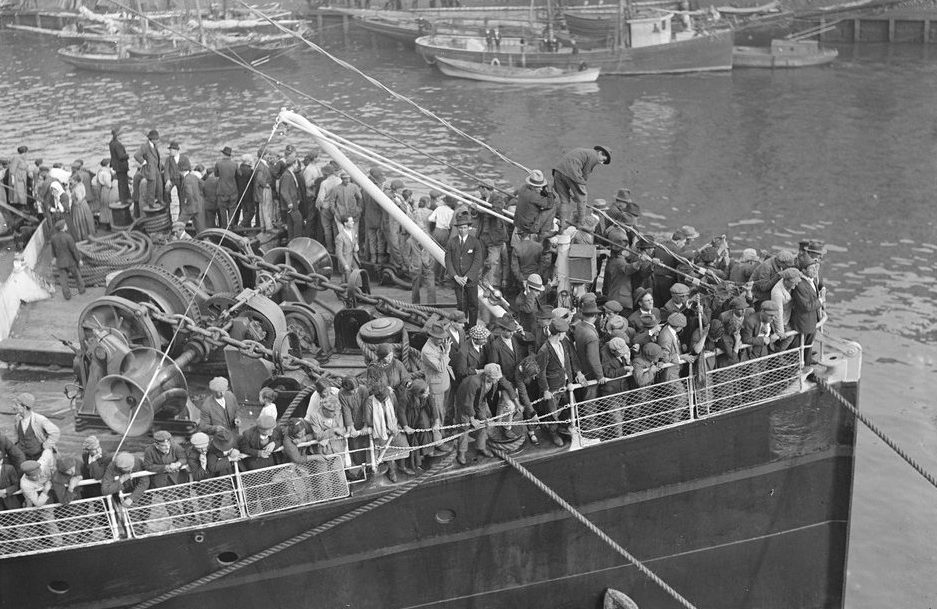

S.S. Canopic lands in Boston, 1920. Photo by Leslie Jones, courtesy of the Boston Public Library

Third-class accommodations, while far from first-class splendor, were a marked improvement over past standards. Two dining saloons, each seating 470, served meals like porridge with milk, smoked herring, jacket potatoes, and roast pork with sage, prepared in a galley producing 60,000 meals per voyage (Lynch, 2018). Cabins offered four- or six-berth layouts with mattresses and blankets, while communal bathrooms and a general room with benches provided respite. Daniel Buckley, an Irish steerage survivor, testified, "We were packed in tight, but it was better than the coffin ships of old. I thought it was my ticket to a new life" (as cited in Lord, 1955, p. 78). Fares of £7 to £8 (about £700 today) made it accessible to laborers and farmers, ensuring White Star a steady profit margin.


The ship’s passenger list revealed a stratified society. First-class luminaries like Astor and Margaret "Molly" Brown occupied suites with private promenades, dining on oysters and filet mignon, while third-class families shared bunks below the waterline. Historian Frances Wilson (2021) writes, "The Titanic was a microcosm of Edwardian society—wealth and want side by side, bound for a new world yet divided by invisible walls" (p. 142). This juxtaposition fueled its cultural resonance, amplified by its sinking, which claimed 68% of third-class passengers versus 40% of first-class (Eaton & Haas, 2013).

The disaster’s societal reverberations were profound. The loss of 1,517 lives—many immigrants—galvanized public outrage, leading to the 1914 International Convention for the Safety of Life at Sea (SOLAS). This treaty mandated lifeboats for all, 24-hour radio watches, and ice patrols, reforms that saved countless lives in subsequent decades (Ballard, 2017). For the immigrant trade, Titanic’s fate was a stark reminder of the journey’s perils, yet liners like Olympic and Cunard’s Aquitania continued ferrying millions until the 1930s, when aviation began to supplant them. The ship’s legacy thus spans both human tragedy and systemic change.


Conclusion


The Titanic was built as a bold synthesis of technological innovation, business strategy, and societal need. It responded to the shipping industry’s cutthroat rivalry, where White Star leveraged size and luxury to challenge Cunard and German competitors, and to the transatlantic migration boom, serving as a conduit for Europe’s displaced millions. Its Olympic-class design—epitomized by its 46,328-ton frame and palatial interiors—was a calculated bid for market dominance, while its steerage capacity addressed the era’s demographic upheaval. As Davenport-Hines (2012) asserts, it was "a monument to Edwardian optimism, a belief that human ingenuity could conquer nature and distance" (p. 31)—a faith tested and broken by its collision with an iceberg.

Beyond its physical form, the Titanic encapsulated the early 20th century’s aspirations: industrial mastery, imperial prestige, and the promise of reinvention across the Atlantic. Its loss exposed the hubris of that vision, yet its influence endures. Historians like Ballard (2017) see it as "a triumph of engineering shadowed by human error" (p. 62), while Lynch (2018) emphasizes its role in "bridging continents and classes" (p. 115). Maxtone-Graham (2014) adds, "It was the pinnacle of an era, a floating dream that sank into history" (p. 93). As a subject of ongoing study, the Titanic remains a prism through which to view the interplay of progress, competition, and human resilience in a transformative age.


References

Ballard, R. D. (2017). Exploring the Titanic: The true story of the world’s most famous shipwreck. Scholastic Press.
Beveridge, B. (2008). Titanic: The ship magnificent (Vol. 1). The History Press.
Davenport-Hines, R. (2012). Voyagers of the Titanic. William Morrow.
Eaton, J. P., & Haas, C. A. (2013). Titanic: Triumph and tragedy (3rd ed.). Haynes Publishing.
Gardiner, R. (Ed.). (2001). The history of the White Star Line. Ian Allan Publishing.
Lord, W. (1955). A night to remember. Henry Holt and Company.
Lynch, D. (2018). Titanic: An illustrated history. Madison Press Books.
Maxtone-Graham, J. (2014). The only way to cross: The golden era of the great Atlantic liners. Bloomsbury Publishing.

You may like these posts

No comments